


New
Risk Assessment
Clairity Breast™ Cancer 5-Year Risk Assessment
Your mammogram may have more to tell you.
First FDA-authorized AI-driven software to assess breast cancer risk.¹
Your 5-year breast cancer risk assessment from your mammogram.
Provider-reviewed results experience with next steps based on national guidelines.
Data backed by studies including 250,000+ screening mammograms in women across the US and Europe.² ³
Clairity Breast™ Cancer 5-Year Risk Assessment
$249
We’ll confirm your mammogram is compatible after purchase. If it isn’t compatible or can’t be scored, you’ll receive a refund.
FSA / HSA accepted
A mammogram may help show whether cancer is visible today. Clairity Breast goes one step further by estimating your personalized 5-year breast cancer risk from that same screening mammogram using FDA-authorized AI-driven software. Your provider may use your risk score to personalize your care plan, including additional screening and risk reduction options.
Why knowing your future risk matters
Clairity Breast assesses your future risk. Now.
Understanding your future risk can help you and your provider make informed decisions about screening and risk-reduction options that may support earlier detection.
85%
of breast cancers occur in women with no family history. Clairity Breast analyzes patterns in your mammogram to assess risk that family history alone can miss.⁵ ⁶
250k+
screening mammograms used to train the AI-driven software to identify breast tissue patterns and assess future risk.² ³
99%
5-year survival rate for breast cancer found early, before it has spread.⁴
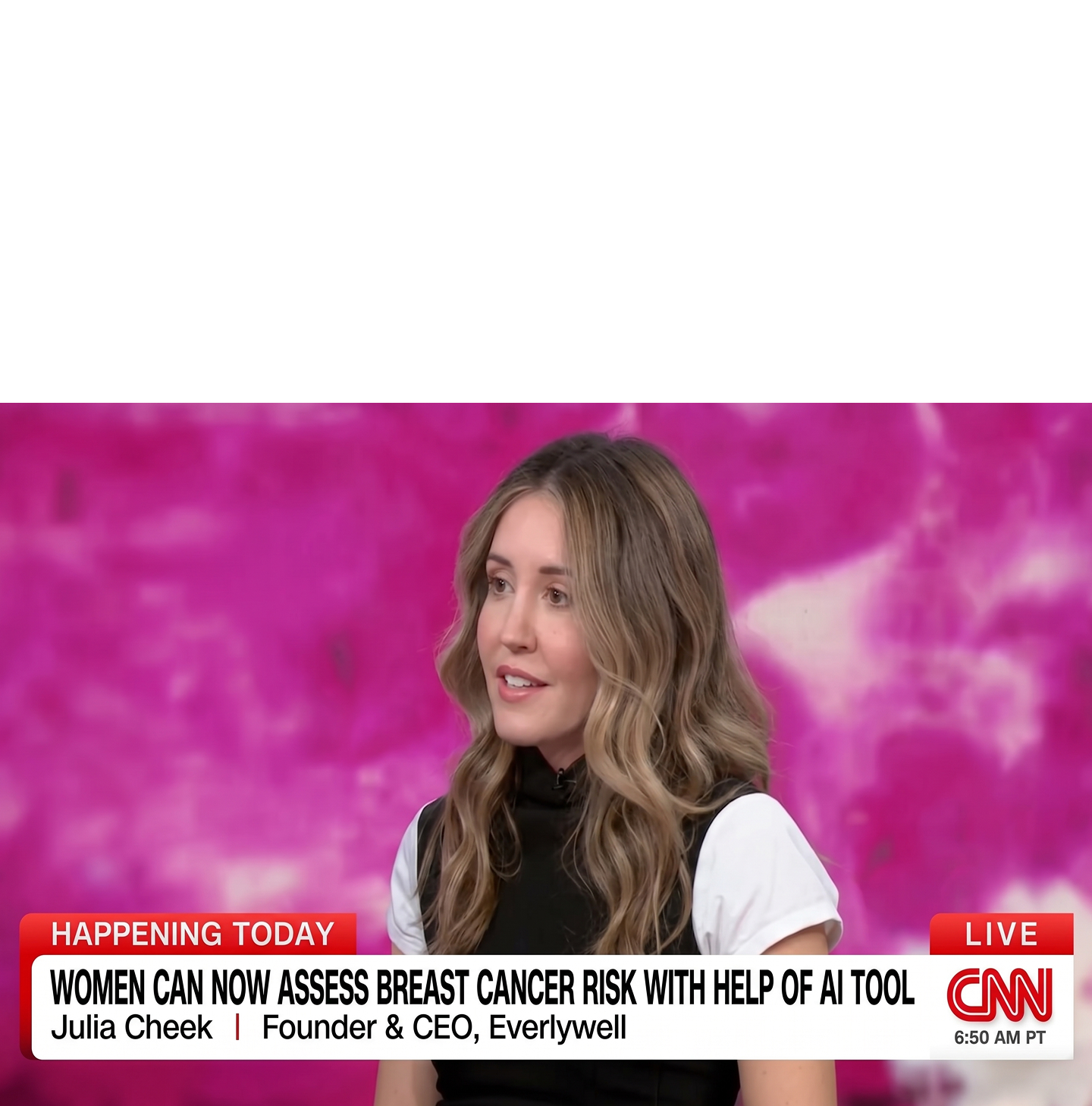
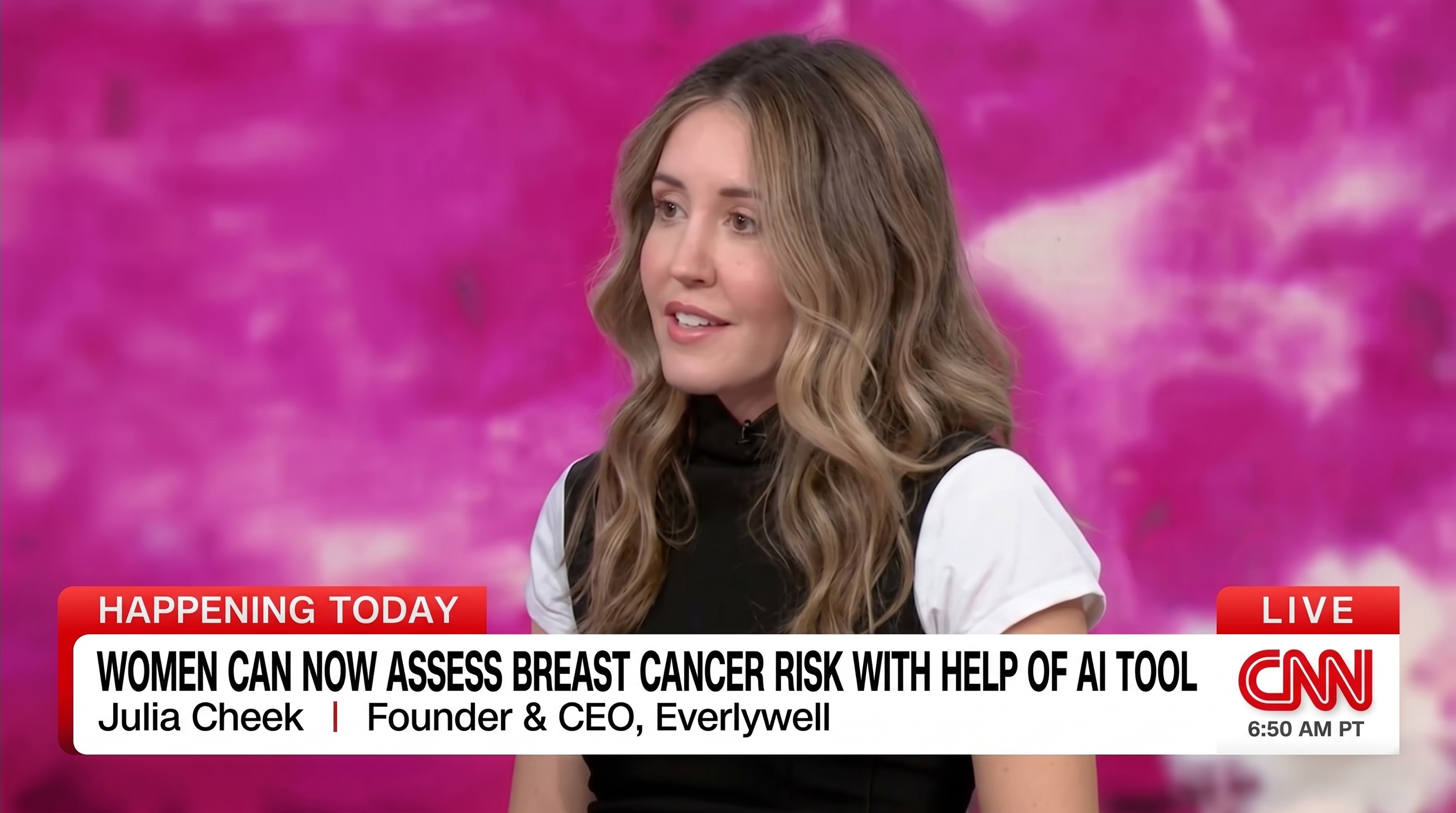
In the news
As seen on CNN
How it works
Before there’s cancer to detect, there’s risk to understand.


Trained on real outcomes
Clairity Breast's AI trained on 250K+ mammograms linked to five years of real outcomes, including women who did and didn't develop breast cancer.² ³


Applied to your mammogram
The AI applies what it learned to your screening mammogram to assess your individual future breast cancer risk.


Risk informs care
Your 5-year risk score gives you and your provider more information to help inform your screening and risk-reduction options.
A next step for dense breasts
About half of women 40 and older have dense breast tissue.⁷
Dense breasts can leave you with questions even after a routine mammogram. Clairity Breast can help you learn more about your future breast cancer risk.
Why dense breasts can mask cancer
Dense breast tissue and possible tumors can both appear white on a mammogram, making them harder to distinguish from one another.⁷
A normal mammogram can still leave questions
Even when no signs of cancer are found, you can now learn more about your future breast cancer risk.
Take the next step
Clairity Breast estimates your 5-year breast cancer risk from your mammogram. Your provider can use your score to discuss additional screening and risk-reduction options.
Your risk score explained
Understanding your Clairity Breast cancer risk score.
High | 3.0%+
Your risk may call for more.
A score in the high range may lead to discussions with your provider about additional screening and risk-reduction options.
Intermediate | 1.7% to 2.9%
Your risk deserves a closer look.
A score in the intermediate range may lead to discussions with your provider about additional screening and risk-reduction options.
Average | Below 1.7%
Keep screening.
Keep informed.
An average risk score usually means your current screening schedule is right for you. It doesn’t mean your risk is zero. Talk with your provider about this result and your history to confirm whether anything else should shape your screening plan.
The three risk score levels are based on thresholds reviewed by Everlywell providers and guidance is provided based on national breast cancer screening guidelines.
Know your risk
Get more insight from your mammogram.


Step 1
Check eligibility
See if you are eligible and if your mammogram qualifies.
Step 2
We handle the retrieval
If you already have a compatible screening mammogram, Clairity Breast can work with your imaging center to retrieve it. If you don't, locate an imaging center where you can get one.
Step 3
Your mammogram is analyzed
Clairity Breast’s FDA-authorized AI-driven software analyzes your mammogram to estimate your breast cancer risk.
Step 4
Receive your results
Your 5-year risk estimate is released to your My Everly account, with guideline-based information to review with your provider.
Need help finding a facility? Find one near you, or contact us at [email protected] / 888-813-0230.


Don't wait. Choose to be informed.
Get your 5-year breast cancer risk assessment.
Learn what your risk range may mean for your care.
Bring guideline-informed information to your provider.
$249
Built by science. Backed by physicians.
“Advancements in AI are unlocking new insights from the data embedded in mammograms, allowing us to identify individuals with a higher risk of developing cancer. These insights can help clinicians tailor each patient’s care plan and adjust it over time.”


Dr. Connie Lehman
Clairity Founder & CEO
Related tests
More ways to invest in your health.


FAQs
Your questions, answered
Disclosure
Clairity Breast provides an estimate of your future breast cancer risk based on your mammogram images. It does not detect or diagnose cancer, and it is not a substitute for ongoing care with your provider. Full Clairity Breast disclosures are available here.
Footnotes
1. Clairity, Inc. "Clairity Becomes the First FDA-Authorized AI Platform for Breast Cancer Prediction, Historic Milestone for Women's Health." BusinessWire, June 2, 2025. businesswire.com/news/home/20250602896762/en/ADDING-MULTIMEDIA-Clairity-Becomes-the-First-FDA-Authorized-AI-Platform-for-Breast-Cancer-Prediction-Historic-Milestone-for-Womens-Health
2. Lehman CD, Hipp E, Scully M, et al. External validation of discrimination and calibration of an image-only AI model for 5-year breast cancer risk prediction across geographically diverse screening sites. RSNA 2025 Scientific Assembly and Annual Meeting; November 30, 2025; Chicago, IL. Abstract S5-SSBR02-5.
3. Morris E, Lehman CD, Miller D, et al. Targeted risk stratification in women under 50 using an image-only AI model: addressing the rise in breast cancer incidence in younger women. RSNA 2025 Scientific Assembly and Annual Meeting; December 2, 2025; Chicago, IL. Abstract #11678.
4. American Cancer Society. "Survival Rates for Breast Cancer." Based on SEER data, cohort diagnosed 2015–2021. cancer.org/cancer/types/breast-cancer/understanding-a-breast-cancer-diagnosis/breast-cancer-survival-rates.html
5. Breastcancer.org. "Breast Cancer Facts and Statistics." breastcancer.org/facts-statistics
6. American Cancer Society. "Genetic Testing for Breast Cancer Risk." cancer.org/cancer/types/breast-cancer/risk-and-prevention/genetic-testing.html
7. Centers for Disease Control and Prevention. "About Dense Breasts." cdc.gov/breast-cancer/about/dense-breasts.html